Why Traditional DLP Struggles with AI Tools
AI tools have changed how data moves through organizations. Here's why many traditional DLP strategies are struggling to keep up.
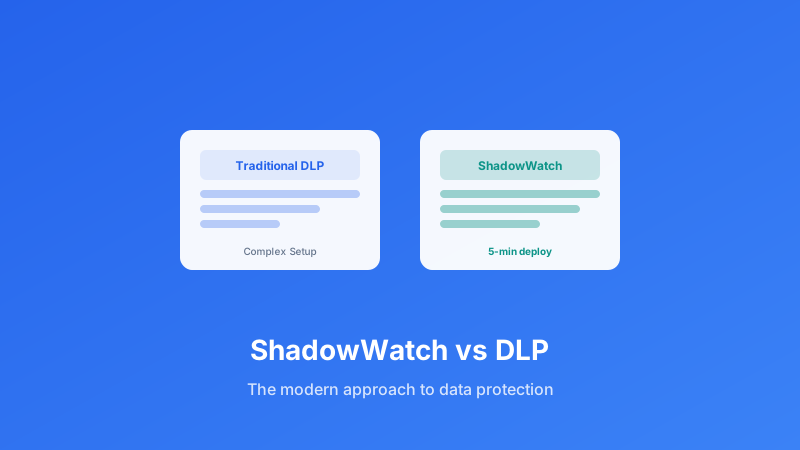
For more than twenty years, Data Loss Prevention (DLP) solutions have helped organizations protect sensitive information. They were designed to identify and control data moving through email, file transfers, cloud storage platforms, and corporate networks.
The rise of AI tools has introduced an entirely new category of data movement.
Employees are no longer just attaching files or sending emails. They’re pasting source code into chatbots, uploading contracts for analysis, summarizing customer records, generating reports, and interacting with dozens of AI services through natural language conversations.
This shift is forcing security teams to reevaluate how they approach data protection.
AI Changes How Data Leaves the Organization
Traditional data exfiltration often involved:
- Email attachments
- USB devices
- Cloud storage uploads
- File transfers
AI tools introduce different behavior:
- Copying and pasting sensitive information into prompts
- Uploading documents directly into AI interfaces
- Sharing source code for troubleshooting
- Using browser extensions and desktop AI applications
- Interacting with unapproved AI tools outside of IT visibility
In many organizations, these activities occur hundreds or thousands of times per day.
Why AI Creates New Challenges
Data Is Shared Through Conversations
Sensitive information is no longer contained solely in files.
An employee can paste intellectual property, customer information, financial data, or credentials directly into a prompt. To a traditional security system, this may look like ordinary text.
Employees Use More AI Tools Than IT Realizes
Most organizations approve a small number of AI platforms.
Employees often use many more.
Security teams regularly discover AI tools that were never reviewed, approved, or added to governance programs. This phenomenon has become known as “Shadow AI.”
Without visibility, organizations cannot effectively manage risk.
Context Matters
Not every prompt is dangerous.
A developer asking an AI tool to explain a programming concept presents a different risk profile than a developer pasting proprietary source code.
Understanding context has become increasingly important as AI adoption grows.
The Emerging AI Governance Gap
Many organizations already have DLP, CASB, secure web gateways, and endpoint protection platforms.
The challenge is not necessarily the absence of security tools.
The challenge is that AI adoption is moving faster than existing governance processes.
Security leaders are asking new questions:
- Which AI tools are employees using?
- What information is being shared?
- Are users sending regulated data to AI providers?
- Which departments are driving adoption?
- How can risky behavior be prevented before exposure occurs?
These questions extend beyond traditional data protection and into AI governance.
Building an AI Security Strategy
Organizations evaluating AI security should focus on four capabilities:
Discovery
Identify which AI tools are actually being used across the organization.
Visibility
Understand what information employees are sharing with those tools.
Policy Enforcement
Apply organizational policies consistently across approved and unapproved AI services.
Auditability
Maintain records that support compliance, investigations, and governance initiatives.
Where ShadowWatch Fits
ShadowWatch was built specifically to address AI-related security and governance challenges.
Rather than replacing existing DLP investments, ShadowWatch complements them by providing visibility into AI tool usage, prompt activity, uploaded content, and policy enforcement before data is transmitted.
As AI adoption accelerates, organizations need more than traditional data protection. They need visibility into how employees are actually using AI.
That visibility is quickly becoming the foundation of effective AI governance.
Ready to secure your AI tools?
Start monitoring your AI interactions today with ShadowWatch.
Start free